
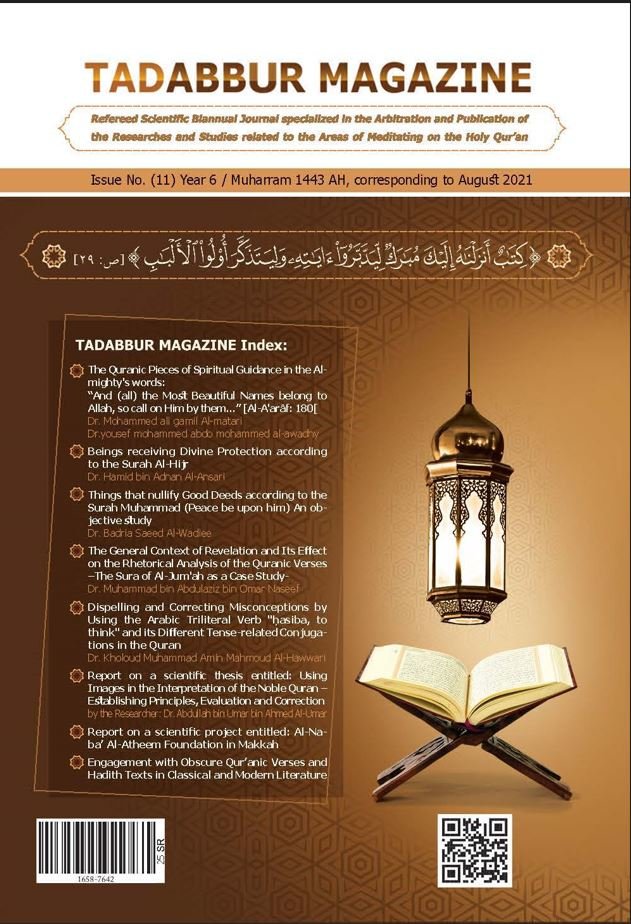
Dispelling and Correcting Misconceptions by Using the Arabic Triliteral Verb "ḥasiba, to think" and its Different Tense-related Conjugations in the Quran

Article Sidebar
submit-article
Submit Article
Introduction Of Tadabbur Journal
visitor
flag_counter
Keywords
Announcements


Latest publications
Browse
index_by
 ISSN
ISSN  ROAD – ISSN Portal
  Crossref
  ici world of journals
  DOI
DOI  Google Scholar
  SUDOC
SUDOC  WorldCat
  BASE
BASE  THE KEEPERS - PKP PN
  OpenAlex
  CLOCKSS
  OAI-PMH – بروتوكول الأرشفة المفتوحة
  مكتبة الكونغرس الأمريكي
  معامل أرسيف – قاعدة معرفة
  MIAR
MIAR  جامعة لايدن – هولندا
  جامعة بريستول – المملكة المتحدة
  اتحاد مكتبات بلجيكا – UniCat
  مكتبة فنلندا الوطنية – Finna
  جامعة خنت – بلجيكا
  EBSCO
EBSCO  University Library
  معرفة
معرفة  Collège de France
  Scientific Journal Impact Factor (SJIF)
  lockss
Main Article Content
Abstract
The aim of the study is to deduce the tools and methods employed by the Noble Quran in dispelling and correcting misconceptions, explore the semantic denotations of the Arabic triliteral verb "ḥasiba" (to think, assume)" and its role in the Quranic usage. The study also examines the impactful concepts based on false allegations and deviant perspectives adopted by some individuals and refutes them while providing a foundation for sound conceptions and a guideline for the rectification of behaviour. These misconceptions total thirteen ones about creed and behaviour, contained in fourteen places where the Arabic triliteral verb "ḥasiba" and its various conjugations are used.
The study used the inductive approach to dealing with the Quranic verses from which the tools and methods of correcting misconceptions can be derived in addition to the verses in which the Arabic triliteral verb "ḥasiba" and its conjugations are used and categorized them into a comprehensive systematic concept. The same approach is used for addressing other Quranic verses dispelling and correcting same misconceptions without using the triliteral verb "ḥasiba", and those particular verses are detailed in the footnotes. The study used the analytical deductive approach for analyzing evidences and identifying those who hold misconceptions and their responses.
The study reached some findings as follows:
- The Noble Quran used different tools and methods to refute and correct misconceptions and all that can confuse truth or normalize falsehoods.
- The verb "ḥasiba" is borrowed from its abstract meaning to a concrete one as if a holder of a misconception goes through a process of accounting and reasoning, which results in his perceptions and assumptions.
The verb "ḥasiba" connotes a dominant and quasi-certain belief. It denotes a belief that is based on knowledge and consideration but questionable. The assumer espouses one of the two extremes without taking the other into his account
- The Noble Quran uses carefully the nuanced denotation of the verb "|ḥasiba" to expose illusions by people who were involved in invalid reasoning and blind reflection, which led them to misconceptions and false beliefs. The usage of the verb "ḥasiba" is intended to correct these misconceptions that have nothing to do with proper knowledge and careful consideration.
The study concluded with some recommendations, the most important of which is that the methods and tools used by the Noble Quran for dispelling and correcting misconceptions should be incorporated into a thorough scholarly treatise.
Downloads
Article Details
Section

This work is licensed under a Creative Commons Attribution 4.0 International License.
Tadabbur Journal operates under the Diamond Open Access model. All articles and reports are published under the Creative Commons Attribution 4.0 International License (CC BY 4.0). https://creativecommons.org/licenses/by/4.0/
Under this license, users are permitted to:
-
Share: Copy and redistribute the material in any medium or format.
-
Adapt: Remix, transform, and build upon the material (including translation or summarization) for any purpose, even commercially.
Subject to the following conditions:
-
Attribution: Users must give appropriate credit to the author(s) and the Journal (as the original publisher), provide a link to the license, and indicate if changes were made.
Copyright Notice: Authors retain full copyright and publishing rights to their work without restrictions, granting the Journal only the right of first publication.