
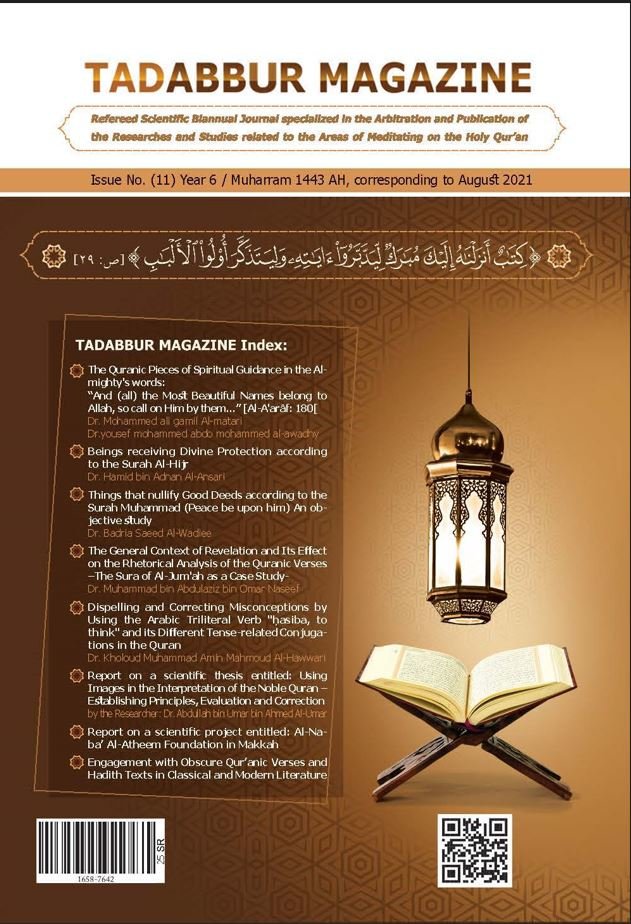
Things that nullify Good Deeds according to the Sura of Muhammad (Peace be upon him) An objective study

Article Sidebar
submit-article
Submit Article
Introduction Of Tadabbur Journal
visitor
Visitor
Keywords
Announcements


Latest publications
Browse
Important_programs_for_researchers

All submitted researches to the Journal will be subject to the program of plagiarism detection
INDEX_1
Journal Indexing & Databases
DOAJ OpenAlex WIKIDATA EBSCO SUDOC CROSSREF (DOI) Google Scholar Search Google Scholar Profile Dimensions BASE Semantic Scholar WORLDCAT SCILITMain Article Content
Abstract
The research addresses an objective study on the things that nullify good deeds as reflected in the Sura of Muhammad (may Allâh’s blessings and peace be upon him) and aims to identify the reasons why good deeds can be neutralized. The word “’amal” (deed) and its different derivatives occur twelve times in the Sura in question.
I relied on the deductive inductive approach in addition to studying, analysis and connection.
Main findings:
1- Allâh is completely aware of His servants’ deeds and He holds them accountable for them, be they good or bad. Whoever performs good deeds will receive a generous reward while wrongdoers will be punished.
2- Misdeeds are normalized for their perpetrators as a punishment appropriate for following their personal inclinations and their incompliance with the commands of Allâh.
3- The nullifiers of good deeds, the most serious of which is unbelief, are to be avoided.
4- Practicing Jihad is the best devotion that preserves a servant’s reward and righteous deeds.
The things that counteract the nullifiers of a believer’s good deeds are as follows:
1- Faith and obedience to Allâh and His Prophet.
2- Practicing Jihad against enemies.
3- Not to make unconditional concessions to the enemies.
Downloads
Article Details
Section

This work is licensed under a Creative Commons Attribution 4.0 International License.
Tadabbur Journal operates under the Diamond Open Access model. All articles and reports are published under the Creative Commons Attribution 4.0 International License (CC BY 4.0). https://creativecommons.org/licenses/by/4.0/
Under this license, users are permitted to:
-
Share: Copy and redistribute the material in any medium or format.
-
Adapt: Remix, transform, and build upon the material (including translation or summarization) for any purpose, even commercially.
Subject to the following conditions:
-
Attribution: Users must give appropriate credit to the author(s) and the Journal (as the original publisher), provide a link to the license, and indicate if changes were made.
Copyright Notice: Authors retain full copyright and publishing rights to their work without restrictions, granting the Journal only the right of first publication.