
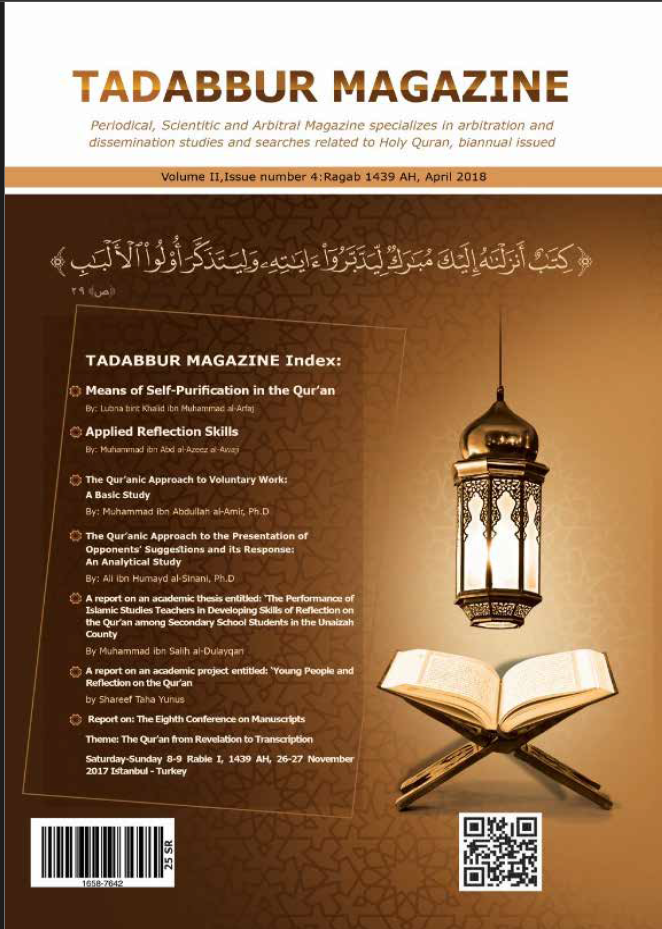
The Qur’anic Approach to Voluntary Work:A Basic Study

Article Sidebar
submit-article
Submit Article
Introduction Of Tadabbur Journal
visitor
flag_counter
Keywords
Announcements


Latest publications
Browse
index_by
 ISSN
ISSN  ROAD – ISSN Portal
  Crossref
  ici world of journals
  DOI
DOI  Google Scholar
  SUDOC
SUDOC  WorldCat
  BASE
BASE  THE KEEPERS - PKP PN
  OpenAlex
  CLOCKSS
  OAI-PMH – بروتوكول الأرشفة المفتوحة
  مكتبة الكونغرس الأمريكي
  معامل أرسيف – قاعدة معرفة
  MIAR
MIAR  جامعة لايدن – هولندا
  جامعة بريستول – المملكة المتحدة
  اتحاد مكتبات بلجيكا – UniCat
  مكتبة فنلندا الوطنية – Finna
  جامعة خنت – بلجيكا
  EBSCO
EBSCO  University Library
  معرفة
معرفة  Collège de France
  Scientific Journal Impact Factor (SJIF)
  lockss
Main Article Content
Abstract
I have endeavoured in this paper to define the concept of volunteering, linguistically and as used by Islamic scholars, sociologists and various international agencies. I explain institutionalised voluntary work, which is predominant in our world as it is adopted and financed by large organisations and governments. I outline the advantages of such institutionalised voluntary work. I then lay down the basis of voluntary work as mentioned in the Qur’an, listing the Qur’anic verses that specifically use the word ‘voluntary’ before adding the verses that refer to the idea of voluntary work. I add a brief explanation of these verses, so as to make their meaning clear without dwelling too long on that. I follow that with practical examples of voluntary work mentioned in the Qur’an and undertaken by prophets or devout people who personally did voluntary work.
The final part of the paper outlines the main conclusions identified by my research, such as: 1) The Qur’an encourages voluntary work in several verses, showing it as one of the best reward-earning good actions; 2) The area of voluntary work is very broad, unlimited to any particular model. It incorporates all that serve people’s interests; and 3) Voluntary work is a method of training which encourages people to give. I then list some recommendations which I believe will help the development of voluntary work within the Muslim community.
May God bestow peace and blessings on Prophet Muhammad and his household.
Downloads
Article Details
Section

This work is licensed under a Creative Commons Attribution 4.0 International License.
Tadabbur Journal operates under the Diamond Open Access model. All articles and reports are published under the Creative Commons Attribution 4.0 International License (CC BY 4.0). https://creativecommons.org/licenses/by/4.0/
Under this license, users are permitted to:
-
Share: Copy and redistribute the material in any medium or format.
-
Adapt: Remix, transform, and build upon the material (including translation or summarization) for any purpose, even commercially.
Subject to the following conditions:
-
Attribution: Users must give appropriate credit to the author(s) and the Journal (as the original publisher), provide a link to the license, and indicate if changes were made.
Copyright Notice: Authors retain full copyright and publishing rights to their work without restrictions, granting the Journal only the right of first publication.