
Conference Management at the European Academy for Qur'anic Studies and the Saudi Scientific Society for the Holy Qur'an and its Sciences (Tebyan)

Article Sidebar
submit-article
Submit Article
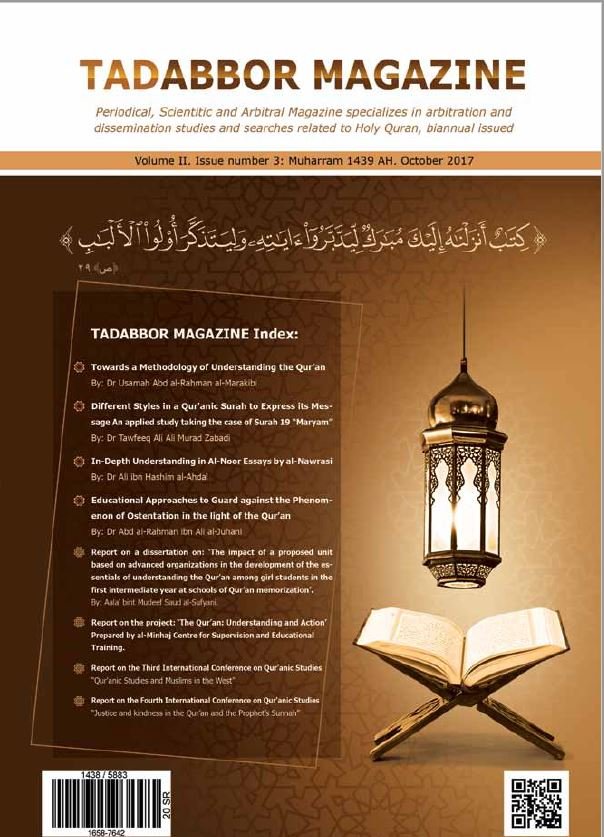
Introduction Of Tadabbur Journal
visitor
Visitor
Keywords
Announcements


Latest publications
Browse
index_by
 ISSN
ISSN  ROAD – ISSN Portal
  Crossref
  ici world of journals
  DOI
DOI  Google Scholar
  SUDOC
SUDOC  WorldCat
  BASE
BASE  THE KEEPERS - PKP PN
  OpenAlex
  CLOCKSS
  OAI-PMH – بروتوكول الأرشفة المفتوحة
  مكتبة الكونغرس الأمريكي
  معامل أرسيف – قاعدة معرفة
  MIAR
MIAR  جامعة لايدن – هولندا
  جامعة بريستول – المملكة المتحدة
  اتحاد مكتبات بلجيكا – UniCat
  مكتبة فنلندا الوطنية – Finna
  جامعة خنت – بلجيكا
  EBSCO
EBSCO  University Library
  معرفة
معرفة  Collège de France
  Scientific Journal Impact Factor (SJIF)
  lockss
Main Article Content
Abstract
The Third International Conference on Qur'anic Studies, titled "Qur'anic Studies and Muslims in the West," was held in Manchester, UK, (July 31 - August 2, 2015). It was organized by the European Academy for Qur'anic Studies and the Saudi Scientific Society for the Holy Qur'an and its Sciences (Tebyan), alongside the University of Salford. The conference aimed to affirm the Qur'an's timeless relevance and utilize Qur'anic studies in educating Muslim youth and addressing community challenges in the West, continuing previous efforts to promote the Qur'an and its contemplation (Tadabbur). Researchers and academics from Arab and European countries participated, presenting 44 papers and four specialized workshops. The conference themes were structured around eight main axes, focusing on: Qur'anic values and their impact on education, manifestations of honoring humanity and women’s rights in the Qur'an, the practical models and influencing factors of Qur'anic Tadabbur, and contemporary methods for teaching and contemplating the Qur'an. Key research topics included Qur'anic dialogue, human rights comparisons with global systems, objectives derived from Qur'anic oaths and narratives, and technology in Qur'an service (e.g., electronic recitation centers). The conferees recommended establishing specialized centers to support Western Muslims through Qur'anic guidance, empowering Muslim women, developing methods for Qur'an comprehension and Tadabbur using modern technology, and clarifying the Qur'an's moderate approach to human rights. It was also agreed to hold the Fourth Conference focusing on: "Justice and Benevolence in the Holy Qur'an and the Prophetic Sunnah."
Downloads
Article Details
Section

This work is licensed under a Creative Commons Attribution 4.0 International License.
Tadabbur Journal operates under the Diamond Open Access model. All articles and reports are published under the Creative Commons Attribution 4.0 International License (CC BY 4.0). https://creativecommons.org/licenses/by/4.0/
Under this license, users are permitted to:
-
Share: Copy and redistribute the material in any medium or format.
-
Adapt: Remix, transform, and build upon the material (including translation or summarization) for any purpose, even commercially.
Subject to the following conditions:
-
Attribution: Users must give appropriate credit to the author(s) and the Journal (as the original publisher), provide a link to the license, and indicate if changes were made.
Copyright Notice: Authors retain full copyright and publishing rights to their work without restrictions, granting the Journal only the right of first publication.