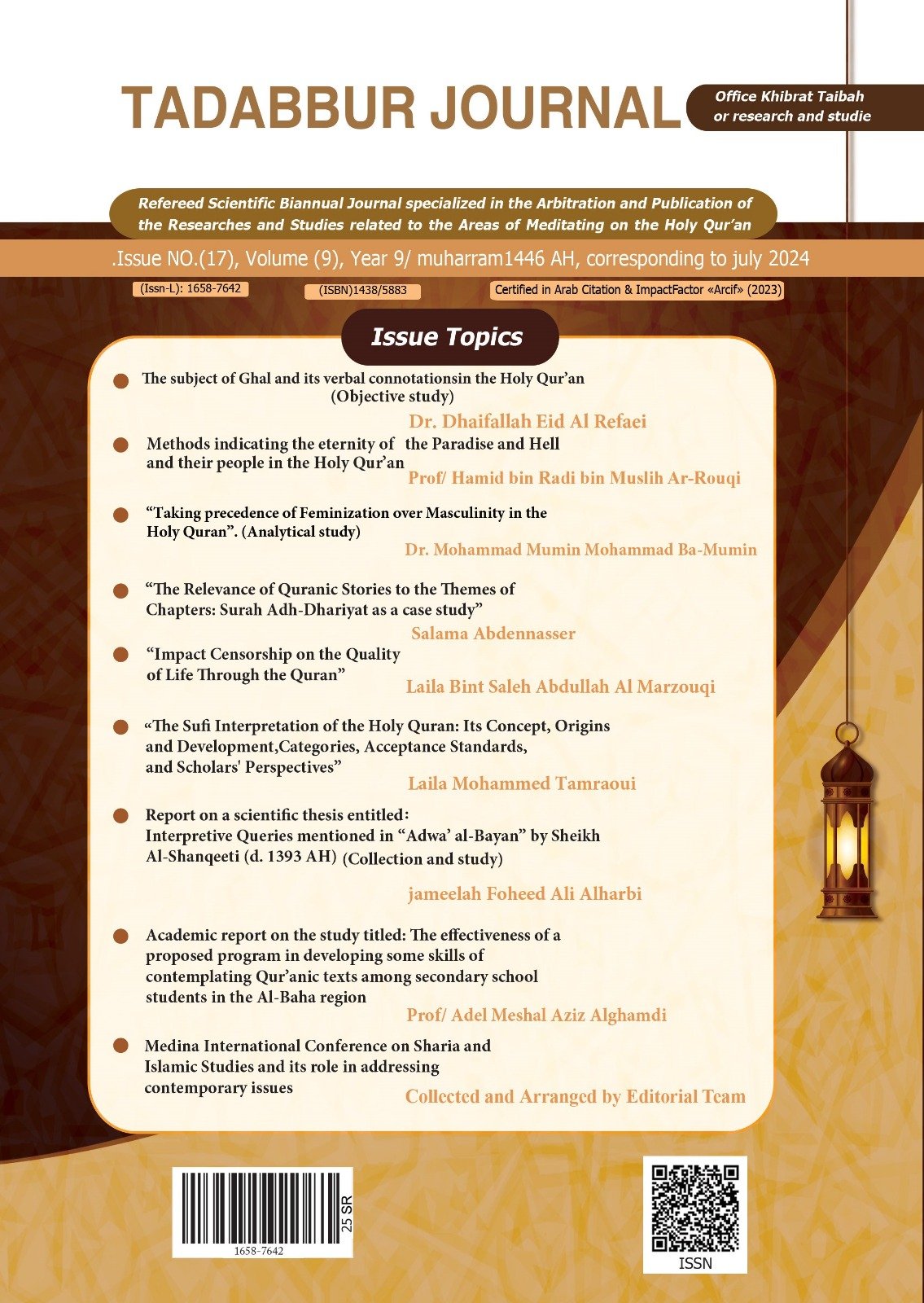
"The Sufi Interpretation of the Holy Quran: Its Concept, Origins and Development, Categories, Acceptance Standards, and Scholars' Perspectives"

Article Sidebar
submit-article
Submit Article
Introduction Of Tadabbur Journal
visitor
Visitor
Keywords
Announcements


Latest publications
Browse
index_by
 ISSN
ISSN  ROAD – ISSN Portal
  Crossref
  ici world of journals
  DOI
DOI  Google Scholar
  SUDOC
SUDOC  WorldCat
  BASE
BASE  THE KEEPERS - PKP PN
  OpenAlex
  CLOCKSS
  OAI-PMH – بروتوكول الأرشفة المفتوحة
  مكتبة الكونغرس الأمريكي
  معامل أرسيف – قاعدة معرفة
  MIAR
MIAR  جامعة لايدن – هولندا
  جامعة بريستول – المملكة المتحدة
  اتحاد مكتبات بلجيكا – UniCat
  مكتبة فنلندا الوطنية – Finna
  جامعة خنت – بلجيكا
  EBSCO
EBSCO  University Library
  معرفة
معرفة  Collège de France
  Scientific Journal Impact Factor (SJIF)
  lockss
Main Article Content
Abstract
The Sufi interpretation of the Quran is closely intertwined with two significant trends that emerged following the expansion of the interpretive model. The first direction is rooted in Eastern spiritual traditions represented by Indian Sufism, Gnosticism, Christian and Jewish monasticism, along with other elements such as Greek philosophy and Neoplatonism. The second direction is influenced by philosophical thought. The dispute about accepting or rejecting this kind of interpretations led some scholars to formulate methodological steps for interpretation, termed as guidelines. This research aims to clarify the concept of Sufi interpretation of the Quran and contextualize it historically to define its boundaries as a concept. It uses a descriptive methodology, which involves surveying and presenting subjects or terms systematically, followed by an analytical approach focused on studying and deconstructing problems. The historical method, aimed at understanding the present in light of past events and developments, also plays a role. Among the research findings is the fact that Sufi interpretation of the Quran is not uniform but varies across history. Most scholars agree that Sufi interpretation of the Quran is only a deduction. Sufi interpretation of the Quran is categorized into three divisions concerning validity and invalidity. Criticism of this interpretive approach began with al-Wahidi (d. 468 AH) in the famous text attributed to him and transmitted by Ibn al-Salah in his fatwas. This attempt discusses the concept of Sufi interpretation, its origin and development, its divisions, acceptance criteria, and the stance of scholars towards it.
Downloads
Article Details
Section

This work is licensed under a Creative Commons Attribution 4.0 International License.
Tadabbur Journal operates under the Diamond Open Access model. All articles and reports are published under the Creative Commons Attribution 4.0 International License (CC BY 4.0). https://creativecommons.org/licenses/by/4.0/
Under this license, users are permitted to:
-
Share: Copy and redistribute the material in any medium or format.
-
Adapt: Remix, transform, and build upon the material (including translation or summarization) for any purpose, even commercially.
Subject to the following conditions:
-
Attribution: Users must give appropriate credit to the author(s) and the Journal (as the original publisher), provide a link to the license, and indicate if changes were made.
Copyright Notice: Authors retain full copyright and publishing rights to their work without restrictions, granting the Journal only the right of first publication.
Author Biography
Laila Mohammed Tamraoui, Morocco
Date and Place of Birth: February 16, 1995, in Zāwiyah al-Shaykh, Kingdom of Morocco.
Diploma in General University Studies in Islamic Studies: Sultan Moulay Slimane University, Beni Mellal, Morocco, completed in 2019.
Bachelor's Degree in Islamic Studies, Specializing in Creed and Fundamentals of Jurisprudence: Completed in 2020 with a thesis titled "The Creedal Orientation of Qira’at Schools According to Exegetes of the Islamic West - Ibn Atiyya's Tafsir as a Model."
Master's Degree in Islamic and Human Sciences, Integration of Methods and Knowledge: Graduated with honors in 2023 from Sultan Moulay Slimane University, Beni Mellal, Morocco, with a thesis titled "The Sufi Interpretation of the Holy Quran: Analysis and Critique."
Selected Publications:
Peer-reviewed Article: "Ibn Atiyya al-Andalusi: His Life and Efforts," published in Marasid Tafsir on September 18, 2021.
Online Scholarly Article: "The Sciences of the Quran and the Principles of Tafsir Included in the Introduction to 'Tashil li Ulum al-Tanzil' by Ibn Juzayy (d. 741 AH)," published by Nama Center for Research and Studies on December 6, 2023.