
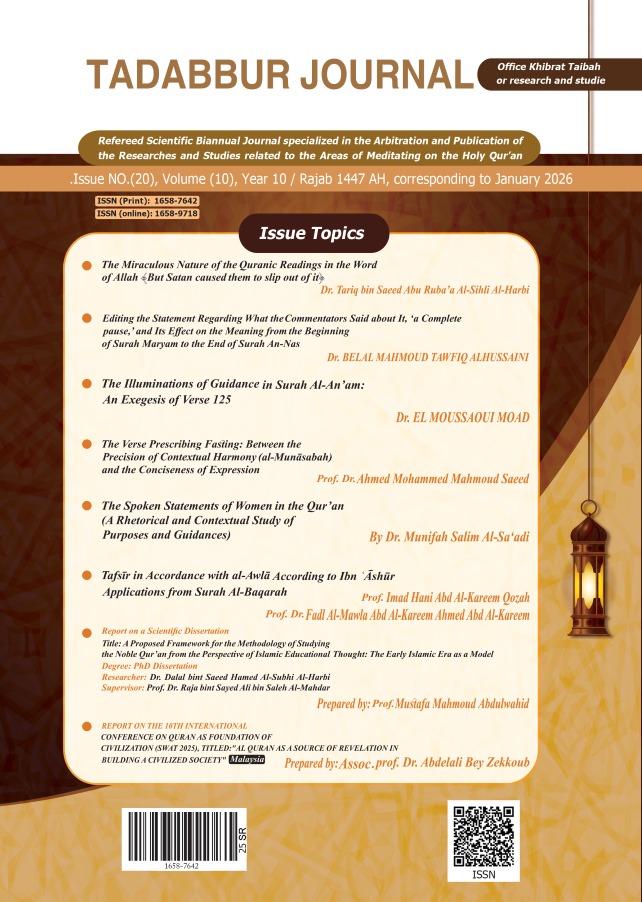
Report on a Scientific Dissertation Title: A Proposed Framework for the Methodology of Studying the Noble Qur'an from the Perspective of Islamic Educational Thought
PhD Dissertation

Article Sidebar
submit-article
Submit Article
Introduction Of Tadabbur Journal
visitor
flag_counter
Keywords
Announcements


Latest publications
Browse
index_by
 ISSN
ISSN  ROAD – ISSN Portal
  Crossref
  ici world of journals
  DOI
DOI  Google Scholar
  SUDOC
SUDOC  WorldCat
  BASE
BASE  THE KEEPERS - PKP PN
  OpenAlex
  CLOCKSS
  OAI-PMH – بروتوكول الأرشفة المفتوحة
  مكتبة الكونغرس الأمريكي
  معامل أرسيف – قاعدة معرفة
  MIAR
MIAR  جامعة لايدن – هولندا
  جامعة بريستول – المملكة المتحدة
  اتحاد مكتبات بلجيكا – UniCat
  مكتبة فنلندا الوطنية – Finna
  جامعة خنت – بلجيكا
  EBSCO
EBSCO  University Library
  معرفة
معرفة  Collège de France
  Scientific Journal Impact Factor (SJIF)
  lockss
Main Article Content
Abstract
The report presents a review of a scholarly thesis entitled: “A Proposed Conception for the Methodology of Studying the Noble Qurʾān from the Perspective of Islamic Educational Thought: The Early Islamic Period as a Model” by the researcher Dalāl bint Saʿīd Ḥāmid al-Ṣubḥī, under the supervision of Professor Dr. Rajāʾ bint Sayyid ʿAlī bin Ṣāliḥ al-Maḥḍār, through which the researcher obtained the degree of Doctorate from the College of Education at Umm al-Qurā University in Mecca the Honored— Kingdom of Saudi Arabia, with an excellent grade. The objectives of the thesis—the subject of the report—center around establishing the intellectual and educational framework for studying the Noble Qurʾān, and rooting its pillars, components, and characteristics from the early Islamic period, in order to construct a methodology and an applied scientific model, as well as a guiding manual that enables the teacher to implement this methodology in contemporary reality. The study proceeds from rooting the intellectual system for educational study and inductively examining its features from the early Islamic period, leading to the crystallization of a contemporary conception and a procedural guide that equips the teacher with mechanisms for field implementation. The thesis is characterized by its balanced integration between authenticity and modernity, aimed at reviving the nation upon the Book of its Lord, the Sunnah of its Prophet Muhammad—peace and blessings be upon him—and the guidance of the righteous predecessors from among the Companions—may God be pleased with them—and those who follow them in excellence until the Day of Judgment. The researcher relied in her thesis on the foundational methodology in its deductive and inductive aspects, in addition to a supporting methodology, namely the descriptive methodology. The researcher concluded in her thesis with several results and recommendations that have been clarified at the conclusion of the report.
Downloads
Article Details
Section

This work is licensed under a Creative Commons Attribution 4.0 International License.
Tadabbur Journal operates under the Diamond Open Access model. All articles and reports are published under the Creative Commons Attribution 4.0 International License (CC BY 4.0). https://creativecommons.org/licenses/by/4.0/
Under this license, users are permitted to:
-
Share: Copy and redistribute the material in any medium or format.
-
Adapt: Remix, transform, and build upon the material (including translation or summarization) for any purpose, even commercially.
Subject to the following conditions:
-
Attribution: Users must give appropriate credit to the author(s) and the Journal (as the original publisher), provide a link to the license, and indicate if changes were made.
Copyright Notice: Authors retain full copyright and publishing rights to their work without restrictions, granting the Journal only the right of first publication.
How to Cite
References
• الصبحي، دلال بنت سعيد، والمحضار، رجاء بنت سيد. (2024). تصوُّر مقترَح لمنهجية تدارُس القرآن الكريم من منظور الفكر التربوي الإسلامي صدر الإسلام أنموذجًا (رسالة دكتوراه غير منشورة). جامعة أم القرى، مكة المكرمة. مسترجَع من: ص:1 إلى ص368.
• السيوطي، عبد الرحمن بن أبي بكر. (1429). الإتقان في علوم القرآن. الهيئة المصرية العامة للكتاب.
• al-Ṣubḥī, Dalāl bint Saʿīd, wa-al-Maḥḍār, Rajāʾ bint Sayyid. "Taṣawwur muqtarah li-manhajīyat tadārus al-Qurʾān al-karīm min manẓūr al-fikr al-tarbawī al-Islāmī ṣadr al-Islām anmūdhajan (risālat duktūrāh ghayr manshūrah)", Jāmiʿat Umm al-Qurá, Makkah al-Mukarramah, mustarjiʿ min: ṣ:1 ilá ṣ:368. Review-required.
• al-Suyūṭī, ʿAbd al-Raḥmān ibn Abī Bakr. "al-Itqān fī ʿulūm al-Qurʾān", al-Hayʾah al-Miṣrīyah al-ʿĀmmah lil-Kitāb, 1429. Fully attested.