
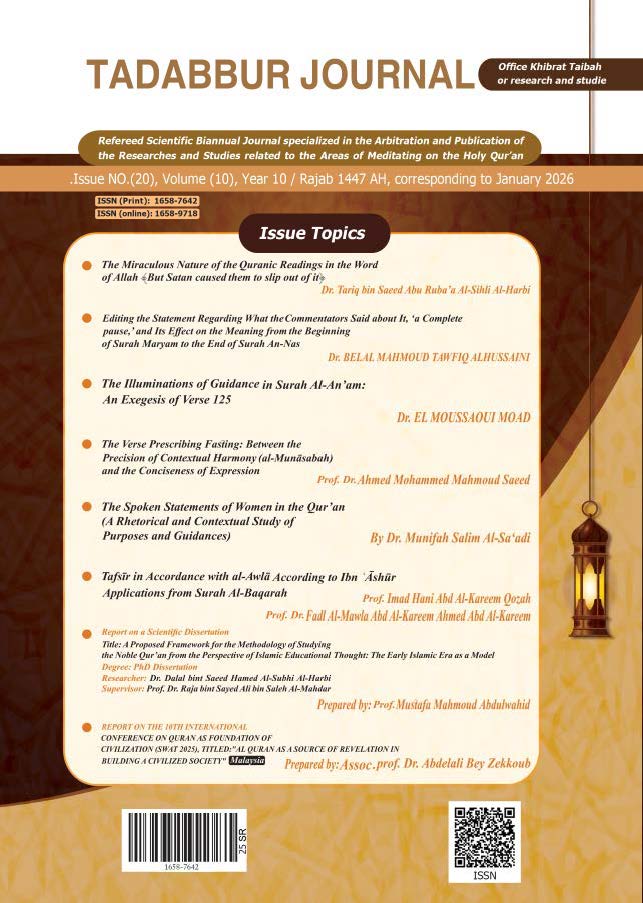
REPORT ON THE 10TH INTERNATIONAL CONFERENCE ON QURAN AS FOUNDATION OF CIVILIZATION (SWAT) 2025, titled: “AL QURAN AS A SOURCE OF REVELATION IN BUILDING A CIVILIZED SOCIETY”
Article Sidebar
ISSN
L-ISSN: 1658-7642 | الرقم الدولي المعياري (مطبوعة)
E-ISSN: 1658-9718 | الرقم الدولي المعياري (إلكترونية)
Tadabbor Journal (Print) – Saudi Arabia
مجلة تدبر (نسخة مطبوعة) – المملكة العربية السعودية
Tadabbor Journal (Online) – Saudi Arabia
مجلة تدبر (نسخة إلكترونية) – المملكة العربية السعودية
Introduction Of Tadabbur Journal
CROSSREF

Search Tadabbur Journal on Crossref
openalex

Search Tadabbur Journal on openalex
Google Scholar

Visit Tadabbur Journal on Google Scholar
ROAD

View Tadabbur Journal ISSN Details
WorldCat

Search Tadabbur Journal on WorldCat
BASE

Search Tadabbur Journal on BASE
Keywords
Announcements


Latest publications
Browse
Main Article Content
Abstract
The report presents an overview of the international scientific conference entitled “The Qur’an as a Source of Revelation in Building a Civilizational Society”, which was held on 12–13 November 2025, corresponding to 19–20 Rabi’ al-Awwal 1445H. The conference was jointly organized by the Faculty of Qur’anic and Sunnah Studies at Universiti Sains Islam Malaysia (USIM), in collaboration with Nasr al-Qur’an, Daffodil International University, and Universiti Tunku Sir Syed Sirajuddin. The conference addressed a central theme: highlighting the Qur’an as a primary source of divine revelation in the construction of a civilizational society, through scholarly approaches that integrate sound Islamic foundations with practical application. It aimed to employ Qur’anic guidance in human development, steer civilizational pathways, reinforce ethical and social values, and confront contemporary intellectual, educational, and technological challenges. The researcher chose to present the conference outcomes to the readers of Tadabbur journal, given their alignment with the journal’s scope, objectives, vision, and mission. The overall aim of the conference was summarized as enhancing the understanding of the Qur’an as a fundamental source for building a balanced civilizational society, by linking its higher objectives with spiritual, social, and scientific values and activating them in contemporary contexts. This goal reflects the conference’s commitment to advancing Qur’anic and Maqasid-oriented research and connecting it with the contemporary issues of the Ummah. The report also presented a variety of research papers, demonstrating the comprehensiveness of the conference and its ability to attract diverse scientific and scholarly perspectives in service of constructing a civilizational society aligned with the teachings of the Qur’an.
Downloads
Article Details
Issue
Section

This work is licensed under a Creative Commons Attribution-NonCommercial-ShareAlike 4.0 International License.
Indicating to the intellectual property, copyrights, and open access right:
According to the Budapest Initiative 2002; tadabbur Journal, which is issued by Khibrat Taibah For Research and Studies in Medina, provides free open access to its publications, and applies the Creative Commons license:
Attribution- Non-Commercial 4.0 International (CC BY-NC 4.0) for the works it publishes from peer-reviewed scientific research and reports, which are freely available on the Internet, and which allows any user to read, download, copy, and distribute (Convert), print, search, or create links to the full texts of the journal’s research and publications, and analyze them in an automatic manner for discovering them, sending them as software data, or using them for any other legal purpose, without financial, legal, or other technical barriers beyond those related to Internet access.
It also highlight that the only barrier to reproduction and distribution, and the only role of copyright in this field, is the necessity of granting the authors of the journal’s research and reports and the publisher the journal; Control over their works, and the right to official recognition and reference citations.
How to Cite
References
1. عبد العالي باي زكوب. 2022. مقاصد البلاء في ضوء القرآن الكريم: دراسة موضوعية. مجلة تدبر 6 (12): 22-155، الرابط: https://doi.org/10.62488/1720-006-012-001
2. عبد العالي باي زكوب. 2024. الذّكاء العاطفي- المفهوم وإشكاليّة الأسلمة من المنظور القرآني: دراسة تحليليّة. الإحسان: مجلة متعددة التخصصات للدراسات الإسلامية. 2 (2): 92-110، الرابط: https://doi.org/10.61166/ikhsan.v2i2.74
3. عبد العالي باي زكوب. 2024. خُطْوات أساسية نحو تدبّرٍ أنفع لكتاب الله عزّ وجلّ: دراسةٌ موضوعيّةٌ تحليليّةٌ. مجلة معالم القرآن والسنة. 20 (1): 1-44، الرابط: https://doi.org/10.33102/jmqs.v20i1.418
4. عَوْدة، جاسر. (2025). المقاصد أساسًا لإطار ومنهجية متكاملة. مجلة الدراسات المقاصدية المعاصرة، 4(1)، 1–20. https://doi.org/10.52100/jcms.v4i1.161
5. متران بسمة عبدالمجيد. 2019. دلالات ومقاصد مصطلح الفرح في القرآن الكريم: نماذج تطبيقية. مجلة تدبر 3 (6): 215-42، الرابط: https://doi.org/10.62488/1720-003-006-005
6. محمود مصطفى. 2025. تقرير عن مؤتمر مقاصد القرآن الكريم: التأصيل والتفعيل، جامعة الشارقة-الإمارات. مجلة تدبر 10 (19): 439-83. الرابط: https://doi.org/10.62488/1720-0010-019-008
7. المؤتمر الدولي العاشر- القرآن كمصدر للبناء الحضاري، الرابط: https://swatfpqs.usim.edu.my، تمت زيارة الموقع: 28/12/2025.
8. المؤتمر الدولي العاشر- القرآن كمصدر للبناء الحضاري، الرابط: https://swatfpqs.usim.edu.my/e-prosiding/ ، تمت زيارة الموقع: 28/12/2025.
9. المؤتمر الدولي العاشر- القرآن كمصدر للبناء الحضاري، أهداف المؤتمر. الرابط: https://swatfpqs.usim.edu.my/objective-purpose-of-conference/، تمت زيارة الموقع: 28/12/2025.
10. المؤتمر الدولي العاشر- القرآن كمصدر للبناء الحضاري، محاور المؤتمر. https://swatfpqs.usim.edu.my/theme/، تمت زيارة الموقع: 28/12/2025.
1. Abdelali Bey Zekkoub. Crucial Steps Towards a More Beneficial Contemplation Upon the Book of Allāh Almighty: A Thematic Analysis Study. Maʿālim Al-Qurʾān Wa Al-Sunnah, 20(1), 1–44. https://doi.org/10.33102/jmqs.v20i1.418
2. Auda, J. (2025). Maqasid as a Basis for an Integrated Framework and Methodology. Journal of Contemporary Maqasid Studies, 4(1), 1–20. https://doi.org/10.52100/jcms.v4i1.161
3. Bey Zekkoub, A. (2024). Emotional Intelligence - The Notion and The Dilemma of Islamization From Qurʾānic Perspective: An Analytical Study. AL-IKHSAN: Interdisciplinary Journal of Islamic Studies, 2(2), 92–110. https://doi.org/10.61166/ikhsan.v2i2.74
4. Bey Zekkoub, A. B. (2022). Maqāṣid al-balāʾ fī ḍawʾ al-Qurʾān al-karīm: Dirāsah mawḍūʿiyyah [The objectives of affliction in the light of the Holy Qurʾān: A thematic study]. Tadabbur Journal, 6(12), 22–155. https://doi.org/10.62488/1720-006-012-001
5. Maḥmūd, M. M. (2025). Taqrīr ʿan muʾtamar maqāṣid al-Qurʾān al-karīm: Al-taʾṣīl wa al-tafʿīl, Jāmiʿat al-Shāriqah–al-Imārāt [Report on the conference “Objectives of the Qurʾān: Foundations and activation,” University of Sharjah, UAE]. Tadabbur Journal, 10(19), 439–483. https://doi.org/10.62488/1720-0010-019-008
6. Mitrān, B. ʿA. (2019). Dalālāt wa-maqāṣid muṣṭalaḥ al-faraḥ fī al-Qurʾān al-karīm: Namādhij taṭbīqiyyah [Meanings and objectives of the term “joy” in the Holy Qurʾān: Applied models]. Tadabbur Journal, 3(6), 215–242. https://doi.org/10.62488/1720-003-006-005
7. The Tenth International Conference: The Qurʾān as a Source for Civilizational Development. (n.d.). https://swatfpqs.usim.edu.my. (Accessed December 28, 2025).
8. The Tenth International Conference: The Qurʾān as a Source for Civilizational Development. (n.d.). E-proceedings. https://swatfpqs.usim.edu.my/e-prosiding/. (Accessed December 28, 2025).
9. The Tenth International Conference: The Qurʾān as a Source for Civilizational Development. (n.d.). Conference objectives. https://swatfpqs.usim.edu.my/objective-purpose-of-conference/. (Accessed December 28, 2025).
10. The Tenth International Conference: The Qurʾān as a Source for Civilizational Development. (n.d.). Conference themes. https://swatfpqs.usim.edu.my/theme/. (Accessed December 28, 2025).