
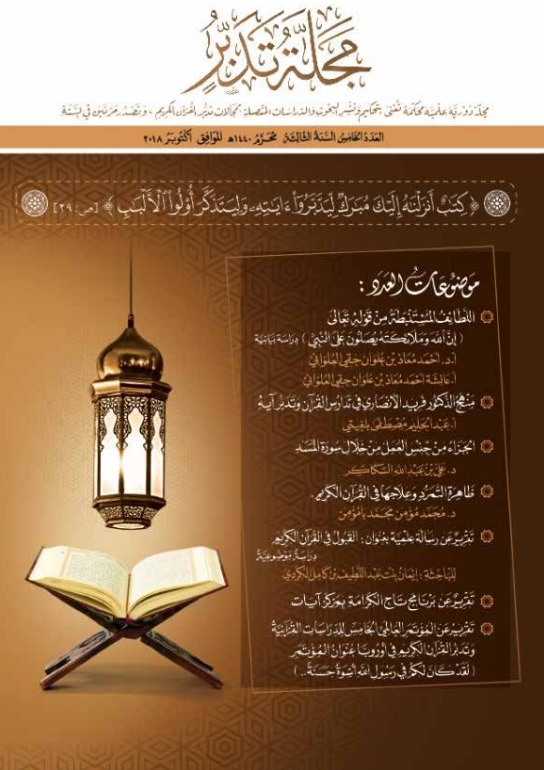
Report on a Master's Thesis Titled: Acceptance in the Holy Quran: An Objective Study

Article Sidebar
submit-article
Submit Article
Introduction Of Tadabbur Journal
visitor
Visitor
Keywords
Announcements


Latest publications
Browse
index_by
 ISSN
ISSN  ROAD – ISSN Portal
  Crossref
  ici world of journals
  DOI
DOI  Google Scholar
  SUDOC
SUDOC  WorldCat
  BASE
BASE  THE KEEPERS - PKP PN
  OpenAlex
  CLOCKSS
  OAI-PMH – بروتوكول الأرشفة المفتوحة
  مكتبة الكونغرس الأمريكي
  معامل أرسيف – قاعدة معرفة
  MIAR
MIAR  جامعة لايدن – هولندا
  جامعة بريستول – المملكة المتحدة
  اتحاد مكتبات بلجيكا – UniCat
  مكتبة فنلندا الوطنية – Finna
  جامعة خنت – بلجيكا
  EBSCO
EBSCO  University Library
  معرفة
معرفة  Collège de France
  Scientific Journal Impact Factor (SJIF)
  lockss
Main Article Content
Abstract
This thesis examines the concept of divine acceptance (al-Qabūl) in the Holy Quran through a thematic methodological approach, submitted in partial fulfillment of the requirements for the Master's degree in Quranic interpretation and sciences. The study was motivated by the dispersal of related material across numerous classical and contemporary Islamic sources without a consolidated reference. The research aims to map the conditions, prerequisites, necessities, nullifiers, and signs of acceptance by Allah, while identifying Quranic figures honored with divine acceptance, elucidating Quranic rhetorical strategies that encourage seeking acceptance, and tracing the degrees and effects of acceptance—both its presence and absence—in this life and the hereafter. The thesis is organized into an introduction, a preface, four chapters, a conclusion, and indices. Key findings include: acceptance belongs solely to Allah and operates on graduated levels according to the spiritual soundness of the heart, conditioned by faith; the lowest degree is salvation from Hellfire while the highest is special divine love; there is a close correlation between the degrees of Paradise and the degrees of acceptance; and a critical distinction exists between the acceptance of a deed per se and the acceptance of the servant as a whole. The study also catalogues the rhetoric employed by the Quran to motivate believers toward seeking acceptance.
Downloads
Article Details
Section

This work is licensed under a Creative Commons Attribution 4.0 International License.
Tadabbur Journal operates under the Diamond Open Access model. All articles and reports are published under the Creative Commons Attribution 4.0 International License (CC BY 4.0). https://creativecommons.org/licenses/by/4.0/
Under this license, users are permitted to:
-
Share: Copy and redistribute the material in any medium or format.
-
Adapt: Remix, transform, and build upon the material (including translation or summarization) for any purpose, even commercially.
Subject to the following conditions:
-
Attribution: Users must give appropriate credit to the author(s) and the Journal (as the original publisher), provide a link to the license, and indicate if changes were made.
Copyright Notice: Authors retain full copyright and publishing rights to their work without restrictions, granting the Journal only the right of first publication.
How to Cite
References
الكردي، إيمان بنت عبد اللطيف بن كامل. "القبول في القرآن الكريم دراسة موضوعية." رسالة ماجستير غير منشورة قسم الدراسات القرآنية، جامعة طيبة، 2013
Al-Kurdi, Iman bint Abd al-Latif bin Kamil. "Al-Qabul fi al-Quran al-Karim: Dirasa Mawdu'iyya." Unpublished Master's Thesis, Department of Quranic Studies, Taibah University, 2013.