
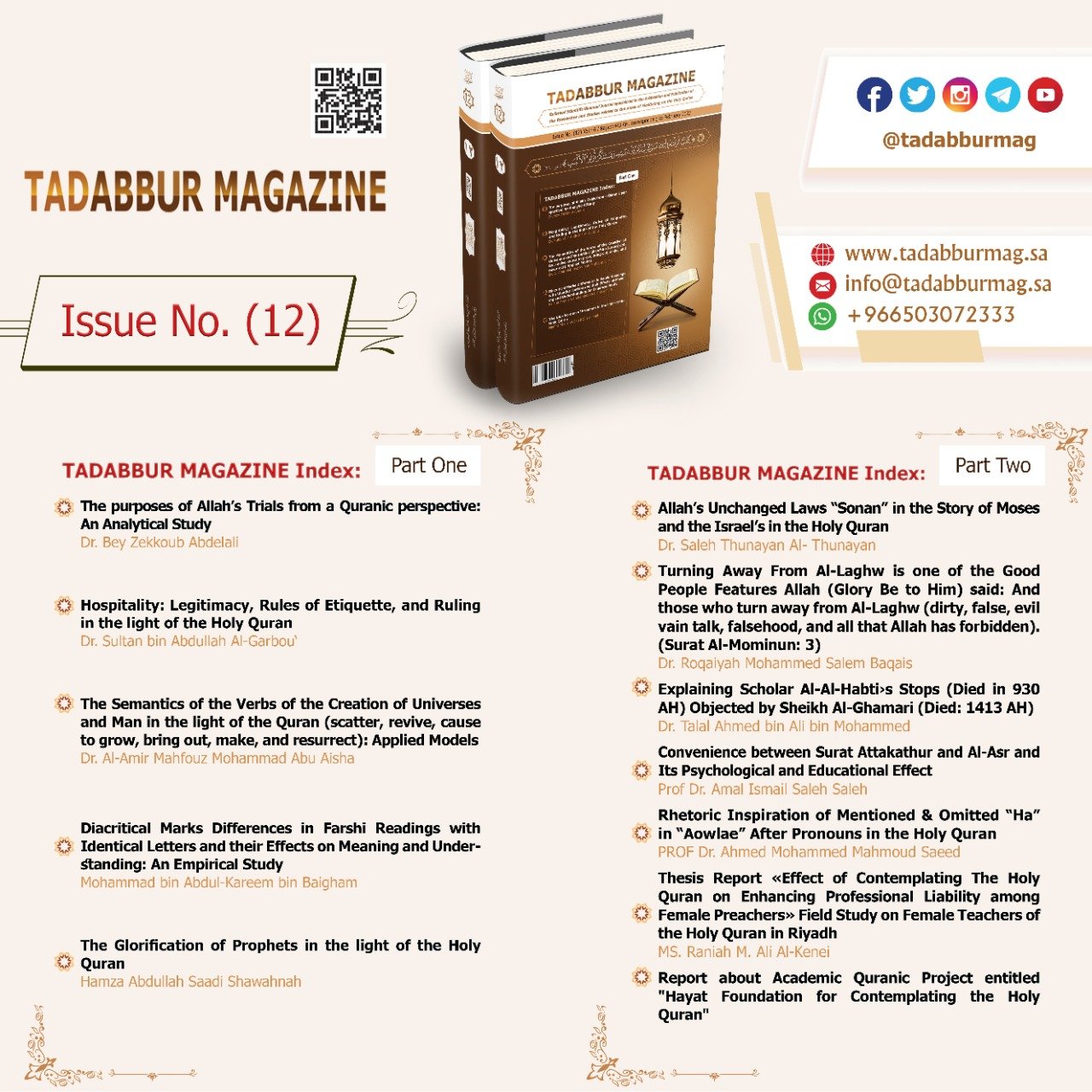
The Semantics of the Verbs of the Creation of Universes and Man in the light of the Quran (scatter, revive, cause to grow, bring out, make, and resurrect): Applied Models

Article Sidebar
submit-article
Submit Article
Introduction Of Tadabbur Journal
visitor
Visitor
Keywords
Announcements


Latest publications
Browse
index_by
 ISSN
ISSN  ROAD – ISSN Portal
  Crossref
  ici world of journals
  DOI
DOI  Google Scholar
  SUDOC
SUDOC  WorldCat
  BASE
BASE  THE KEEPERS - PKP PN
  OpenAlex
  CLOCKSS
  OAI-PMH – بروتوكول الأرشفة المفتوحة
  مكتبة الكونغرس الأمريكي
  معامل أرسيف – قاعدة معرفة
  MIAR
MIAR  جامعة لايدن – هولندا
  جامعة بريستول – المملكة المتحدة
  اتحاد مكتبات بلجيكا – UniCat
  مكتبة فنلندا الوطنية – Finna
  جامعة خنت – بلجيكا
  EBSCO
EBSCO  University Library
  معرفة
معرفة  Collège de France
  Scientific Journal Impact Factor (SJIF)
  lockss
Main Article Content
Abstract
The study of the Quranic verbs that refer to creation and origination is a complex topic that receives considerable attention in Islamic thought on the basis that they are attributed to Allah, the Almighty. They contain axioms and lessons for every responsible adult. These verbs also reveal the inimitability of the Quran as the top miracle of the Prophet’s that will last until the Day of Resurrection. This paper is entitled "The Semantics of the Verbs of the Creation of Universes and Man in the light of the Quran (scatter, revive, cause to grow, bring out, make, and resurrect): Applied Models"
- The rationale for studying the verbs of creation and origination: the study is carried out for science and religious purposes because some of our contemporary young people have become less faithful and Islamic thought is in dire need of elucidating the implications and meanings of these verbs.
- The main objective of the study is to show evidence of belief in Allah, the omnipotent who creates all beings and creatures out of pure nothingness.
The study uses the descriptive analytical method.
- The findings of the study: it reaches some conclusions that prove creeds, bring to light the divine bestowals and blessings and make a compelling response to those who repudiate Final Resurrection.
- The study recommends that all researchers should explore the Quranic vocabulary in general and the verbs denoting creation and origination in particular.
Downloads
Article Details
Section

This work is licensed under a Creative Commons Attribution 4.0 International License.
Tadabbur Journal operates under the Diamond Open Access model. All articles and reports are published under the Creative Commons Attribution 4.0 International License (CC BY 4.0). https://creativecommons.org/licenses/by/4.0/
Under this license, users are permitted to:
-
Share: Copy and redistribute the material in any medium or format.
-
Adapt: Remix, transform, and build upon the material (including translation or summarization) for any purpose, even commercially.
Subject to the following conditions:
-
Attribution: Users must give appropriate credit to the author(s) and the Journal (as the original publisher), provide a link to the license, and indicate if changes were made.
Copyright Notice: Authors retain full copyright and publishing rights to their work without restrictions, granting the Journal only the right of first publication.