
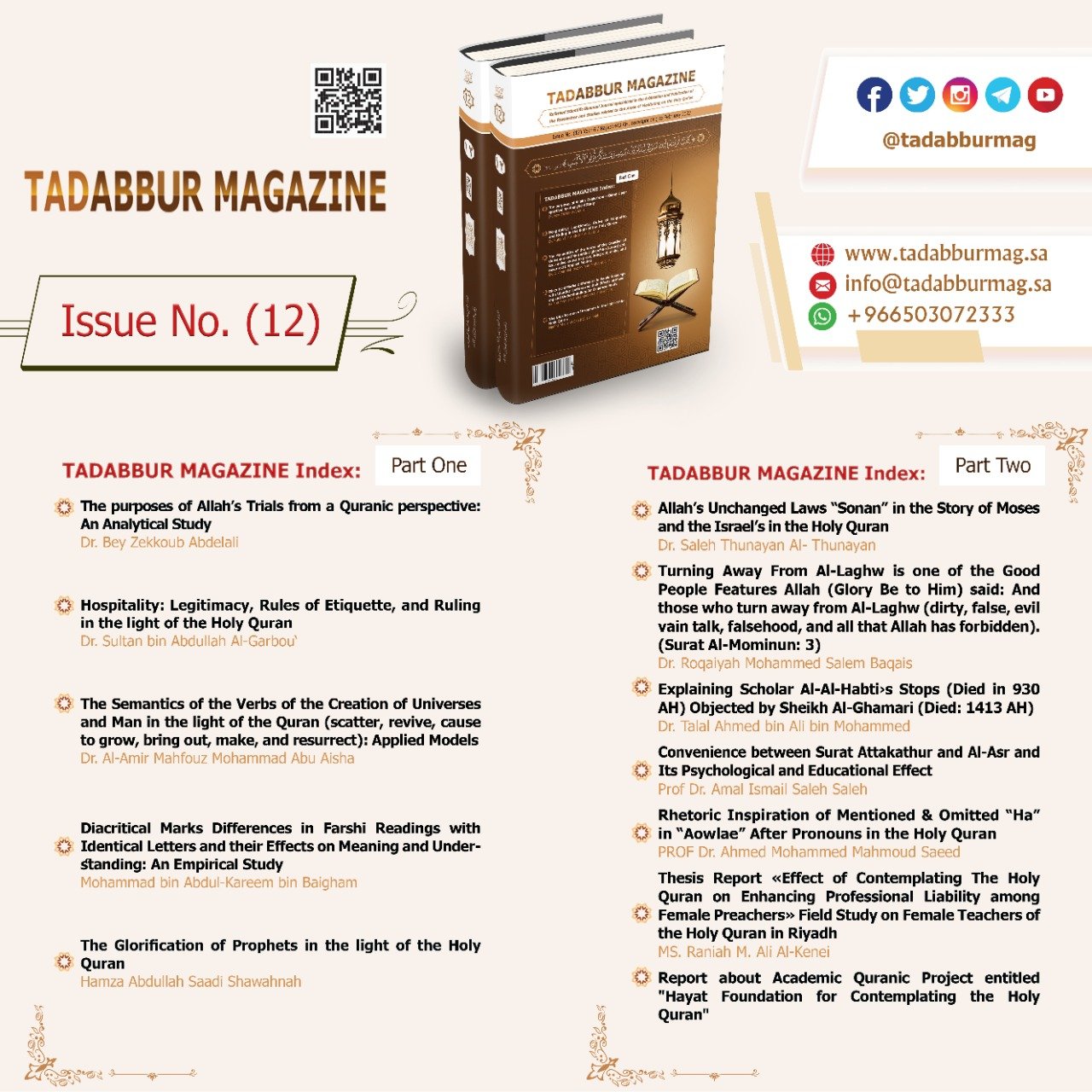
Turning Away From Al-Laghw is one of the Good People Features Allah (Glory Be to Him) said: And those who turn away from Al-Laghw (Surat Al-Mominun: 3)

Article Sidebar
submit-article
Submit Article
Introduction Of Tadabbur Journal
visitor
Visitor
Keywords
Announcements


Latest publications
Browse
index_by
 ISSN
ISSN  ROAD – ISSN Portal
  Crossref
  ici world of journals
  DOI
DOI  Google Scholar
  SUDOC
SUDOC  WorldCat
  BASE
BASE  THE KEEPERS - PKP PN
  OpenAlex
  CLOCKSS
  OAI-PMH – بروتوكول الأرشفة المفتوحة
  مكتبة الكونغرس الأمريكي
  معامل أرسيف – قاعدة معرفة
  MIAR
MIAR  جامعة لايدن – هولندا
  جامعة بريستول – المملكة المتحدة
  اتحاد مكتبات بلجيكا – UniCat
  مكتبة فنلندا الوطنية – Finna
  جامعة خنت – بلجيكا
  EBSCO
EBSCO  University Library
  معرفة
معرفة  Collège de France
  Scientific Journal Impact Factor (SJIF)
  lockss
Main Article Content
Abstract
Research Subject:
Turning Away From Al-Laghw is one of the Successful Features
Allah (Glory Be to Him) said:
And those who turn away from Al-Laghw (Surat Al-Mominun: 3)
Research Objectives
Discussing a feature of the successful; turning away from Al-Laghw as well as defining Al-Laghw in the Quranic verse, the meaning of turning away from it, and how this will be a reason for success and gaining paradise.
Research Problem
What is meant by Laghw in general and its meaning in Surat Al-Mominun in particular? What does “Turning away from Al-Laghw” means? How is “Turning away from Al-Laghw” is considered one of the features of the successful?
Analytical and objective study of the research vocabulary and deducting he secrets and rhetoric meanings.
Research Findings
Introducing “Surat Al-Mominun” and the feature of “Turning away from Al-Laghw” and defining the “Laghw” which is considered a feature of the successful and a reason for gaining paradise.
Stating that Al-Laghw is all useless speech and actions leading to nothing. Showing the opinions of the Quran Interpretation in stating “Al-Laghw” meaning, and the way it can be “turned away from” to be a reason for success.
Identifying the directions and deductions from the holy verse.
This is meant to develop the contemplation traits in the Holy Qura and bnefit the faithful in this world and afterlife.
Downloads
Article Details
Section

This work is licensed under a Creative Commons Attribution 4.0 International License.
Tadabbur Journal operates under the Diamond Open Access model. All articles and reports are published under the Creative Commons Attribution 4.0 International License (CC BY 4.0). https://creativecommons.org/licenses/by/4.0/
Under this license, users are permitted to:
-
Share: Copy and redistribute the material in any medium or format.
-
Adapt: Remix, transform, and build upon the material (including translation or summarization) for any purpose, even commercially.
Subject to the following conditions:
-
Attribution: Users must give appropriate credit to the author(s) and the Journal (as the original publisher), provide a link to the license, and indicate if changes were made.
Copyright Notice: Authors retain full copyright and publishing rights to their work without restrictions, granting the Journal only the right of first publication.