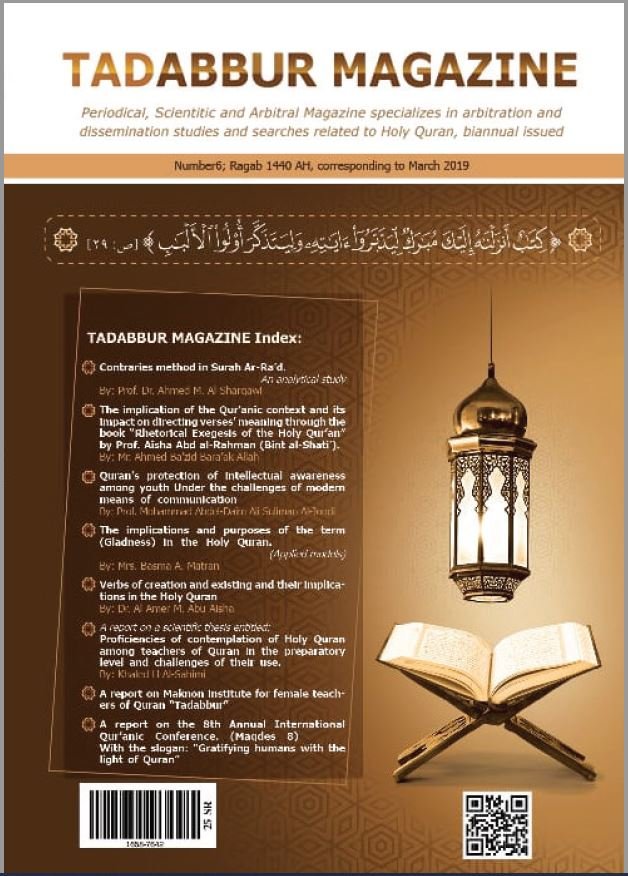
The implication of the Qur'anic context and its impact on directing verses' meaning through the book "Rhetorical Exegesis of the Holy Qur'an" by Prof. Aisha Abd al-Rahman (Bint al-Shati’).
Article Sidebar
ISSN
L-ISSN: 1658-7642 | الرقم الدولي المعياري (مطبوعة)
E-ISSN: 1658-9718 | الرقم الدولي المعياري (إلكترونية)
Tadabbor Journal (Print) – Saudi Arabia
مجلة تدبر (نسخة مطبوعة) – المملكة العربية السعودية
Tadabbor Journal (Online) – Saudi Arabia
مجلة تدبر (نسخة إلكترونية) – المملكة العربية السعودية
Introduction Of Tadabbur Journal
CROSSREF

Search Tadabbur Journal on Crossref
openalex

Search Tadabbur Journal on openalex
Google Scholar

Visit Tadabbur Journal on Google Scholar
ROAD

View Tadabbur Journal ISSN Details
WorldCat

Search Tadabbur Journal on WorldCat
BASE

Search Tadabbur Journal on BASE
Keywords
Announcements


Latest publications
Browse
Main Article Content
Abstract
Firstly: The importance of the study.
It is obvious to the contemplative in the exegesis legacy of scholars and imams of ancestors and descendants the presence of consideration the context in interpreting the texts of the Quran. According to that, this study is an attempt to reveal the features of following this presumption in Quran exegesis and its impact on directing and preferring verses' meaning through the book "Rhetorical Exegesis of the Noble Qur'an". The researcher adopted an overall approach that integrates descriptive, extrapolation and analysis tools, trying to uncover the essences of the book and its contents, doctrines and sources. The research also goes deeply into analyzing the context, types and roles of the book according to Dr. Aisha Abdel Rahman, as for the researcher emphasizing his idea by examples of exegesis from her book. And then the researcher tries to generalize the author's dependence on the context in the interpretation of the Quran verses and the weighting between the meanings and different interpretative words about them and the criticism in light of that.
Secondly: The purposes and objectives of the study.
The research pursues a number of purposes that can be summarized in:
- Explaining the importance of the significance of the context in the exegesis and its impact on directing the meanings of the verses.
2. Introducing Prof. Aisha Abd al-Rahman and her book.3. Revealing the effect of considering the significance of the context in criticizing the exegesis words and the weighting between the meanings of the verses through the interpretation of some Quranic surahs through the book of Prof. Aisha Abdul Rahman.4. Highlighting the diversity of context functions in directing the meanings of the verses and weighting between exegesis words. Thirdly: The results of the study.The research finally concluded after generalizing and following the features of the author's work the following conclusions: 1. The importance and centrality of considering the contextual significance in its interpretative approach. This meaning is becoming clearer when we noticed her major adoption on the context presumption of argumentation theory and discussing words of interpreters between acceptance and rejection some of it, in accordance to their agreeing or disagreeing with the context whether it is literal or applied. This is evidenced by many expressions such as (and this what the context rejects).2. There are many functions of the Quranic context in Bint al-Shati’ exegesis, such as, weighting function, explaining function and augmenting function, all serve the author's approach in interpreting the verses, and her major adoption on it has been shown in directing the meaning of the verses in line with its requirement.3. An important matter can be noticed while talking about results, which is the richness of the cognitive and scientific sources of the author in creating the contextual arguments of the verses.
Downloads
Article Details
Section

This work is licensed under a Creative Commons Attribution-NonCommercial-ShareAlike 4.0 International License.
Indicating to the intellectual property, copyrights, and open access right:
According to the Budapest Initiative 2002; tadabbur Journal, which is issued by Khibrat Taibah For Research and Studies in Medina, provides free open access to its publications, and applies the Creative Commons license:
Attribution- Non-Commercial 4.0 International (CC BY-NC 4.0) for the works it publishes from peer-reviewed scientific research and reports, which are freely available on the Internet, and which allows any user to read, download, copy, and distribute (Convert), print, search, or create links to the full texts of the journal’s research and publications, and analyze them in an automatic manner for discovering them, sending them as software data, or using them for any other legal purpose, without financial, legal, or other technical barriers beyond those related to Internet access.
It also highlight that the only barrier to reproduction and distribution, and the only role of copyright in this field, is the necessity of granting the authors of the journal’s research and reports and the publisher the journal; Control over their works, and the right to official recognition and reference citations.