
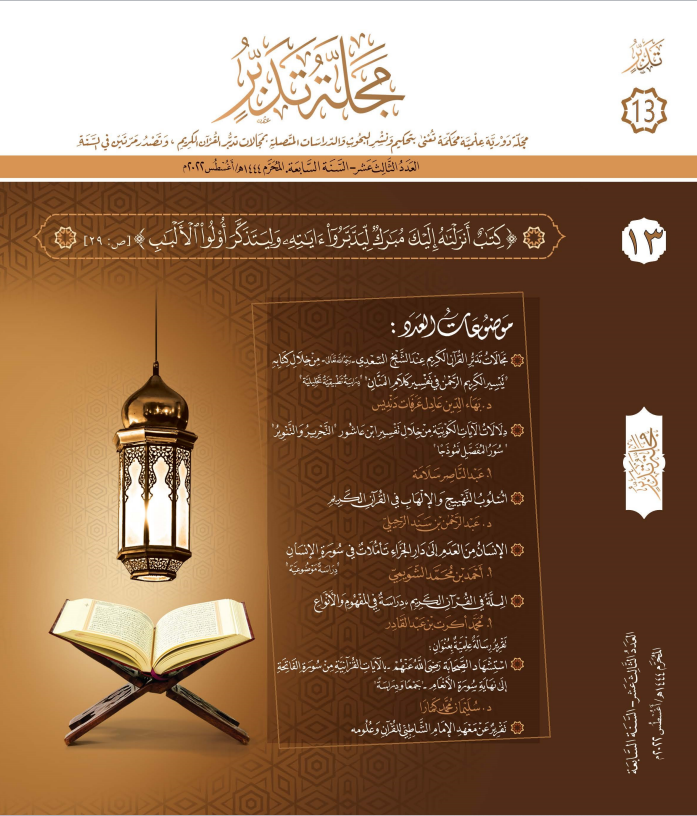
Report on a Thesis Titled: "The Sahabah's (May Allah be pleased with them) Citations of Quranic Verses from Surat Al-Fatihah to the end of Surat Al-An'am: A Collection and Study"

Article Sidebar
submit-article
Submit Article
Introduction Of Tadabbur Journal
visitor
Visitor
Keywords
Announcements


Latest publications
Browse
index_by
 ISSN
ISSN  ROAD – ISSN Portal
  Crossref
  ici world of journals
  DOI
DOI  Google Scholar
  SUDOC
SUDOC  WorldCat
  BASE
BASE  THE KEEPERS - PKP PN
  OpenAlex
  CLOCKSS
  OAI-PMH – بروتوكول الأرشفة المفتوحة
  مكتبة الكونغرس الأمريكي
  معامل أرسيف – قاعدة معرفة
  MIAR
MIAR  جامعة لايدن – هولندا
  جامعة بريستول – المملكة المتحدة
  اتحاد مكتبات بلجيكا – UniCat
  مكتبة فنلندا الوطنية – Finna
  جامعة خنت – بلجيكا
  EBSCO
EBSCO  University Library
  معرفة
معرفة  Collège de France
  Scientific Journal Impact Factor (SJIF)
  lockss
Main Article Content
Abstract
This study examines the practice of the Prophet's Companions (may Allah be pleased with them) of citing Quranic verses in their transmitted reports (athar), covering the chapters from Surat Al-Fatiha to the end of Surat Al-An'am, through a comprehensive collection and foundational analytical study. The significance of the study stems from the fact that the Companions' exegesis constitutes the third primary source in the science of Quranic interpretation; however, this particular mode of interpretation — namely, the citation of verses within transmitted reports — has not received sufficient attention in specialized scholarly literature. The study aimed to collect and isolate these reports for dedicated research, highlight the Companions' heritage of Quranic citation, clarify the correct methodology for deriving Quranic meanings, and elucidate scholarly approaches to utilizing the Companions' statements for exegetical purposes. The study adopted an inductive methodology by systematically surveying works of transmitted exegesis, including the commentaries of Ibn Jarir, Ibn Abi Hatim, Ibn al-Mundhir, Al-Baghawi, Ibn Kathir, and Al-Suyuti's Al-Durr Al-Manthur, with a requirement that chains of transmission be sound or good. The study reached several key findings: it examined 123 transmitted reports attributed to 23 Companions, with Ibn Abbas (may Allah be pleased with him) being the most prolific in Quranic citation at 48 instances, followed by Ibn Mas'ud at 17, and Ibn Umar at 10. The study further demonstrated that the Companions' exegesis ranges from the explicitly clear to the inferential, requiring the application of legal principles for derivation; that reports clarifying Quranic vocabulary typically do so based on Quranic usage rather than purely linguistic definitions; and that the exegetes' methodology in applying principles of legal theory is broader than that of the jurists, as they apply these rules across all verses, not merely the legal ones.
Downloads
Article Details
Section

This work is licensed under a Creative Commons Attribution 4.0 International License.
Tadabbur Journal operates under the Diamond Open Access model. All articles and reports are published under the Creative Commons Attribution 4.0 International License (CC BY 4.0). https://creativecommons.org/licenses/by/4.0/
Under this license, users are permitted to:
-
Share: Copy and redistribute the material in any medium or format.
-
Adapt: Remix, transform, and build upon the material (including translation or summarization) for any purpose, even commercially.
Subject to the following conditions:
-
Attribution: Users must give appropriate credit to the author(s) and the Journal (as the original publisher), provide a link to the license, and indicate if changes were made.
Copyright Notice: Authors retain full copyright and publishing rights to their work without restrictions, granting the Journal only the right of first publication.
How to Cite
References
كامارا، سليمان محمد. "استشهاد الصحابة رضي الله عنهم بالآيات القرآنية من سورة الفاتحة إلى نهاية سورة الأنعام — جمعاً ودراسة." رسالة دكتوراه غير منشورة، إشراف د.حكمت بشير ياسين، الجامعة الإسلامية بالمدينة المنورة، 1443هـ.
Kāmārā, Sulaymān Muḥammad. "Istishhād al-ṣaḥābah raḍiya Allāh ʻanhum bil-āyāt al-Qurʼāniyyah min Sūrat al-Fātiḥah ilá nihāyat Sūrat al-Anʻām — jamʻan wa-dirāsah." Risālat duktūrāh ghayr manshūrah, ishrāf Dr. Ḥikmat Bashīr Yāsīn, al-Jāmiʻah al-Islāmiyyah bi-al-Madīnah al-Munawwarah, 1443 H.