
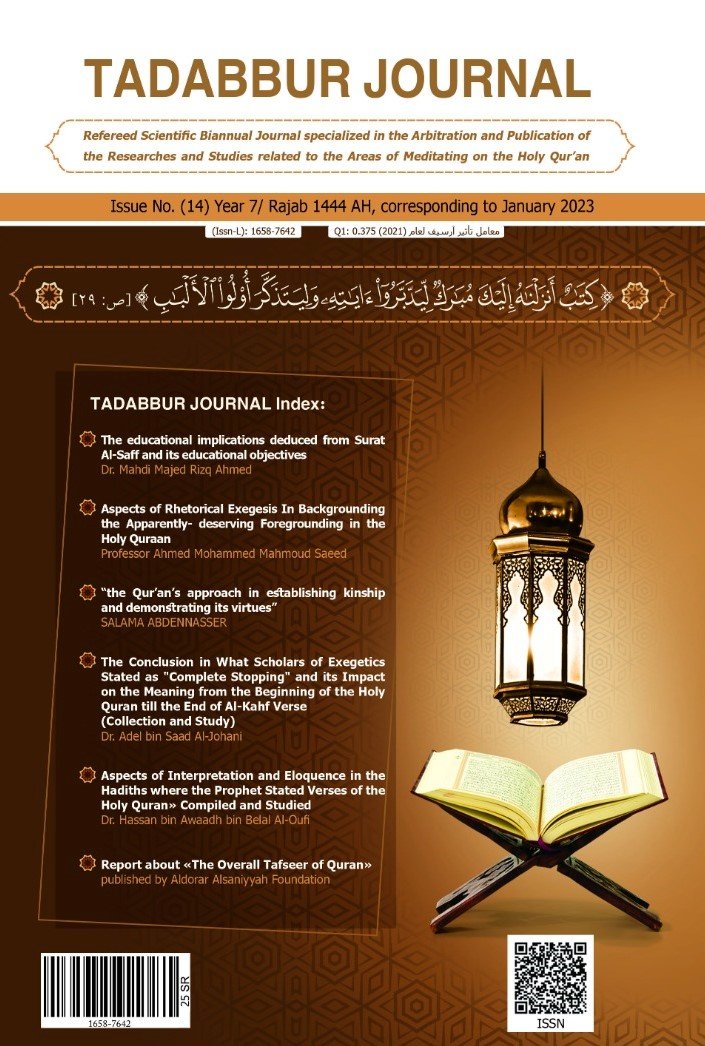
Aspects of Rhetorical Exegesis In Backgrounding the Apparently- deserving Foregrounding in the Holy Quraan

Article Sidebar
submit-article
Submit Article
Introduction Of Tadabbur Journal
visitor
Visitor
Keywords
Announcements


Latest publications
Browse
index_by
 ISSN
ISSN  ROAD – ISSN Portal
  Crossref
  ici world of journals
  DOI
DOI  Google Scholar
  SUDOC
SUDOC  WorldCat
  BASE
BASE  THE KEEPERS - PKP PN
  OpenAlex
  CLOCKSS
  OAI-PMH – بروتوكول الأرشفة المفتوحة
  مكتبة الكونغرس الأمريكي
  معامل أرسيف – قاعدة معرفة
  MIAR
MIAR  جامعة لايدن – هولندا
  جامعة بريستول – المملكة المتحدة
  اتحاد مكتبات بلجيكا – UniCat
  مكتبة فنلندا الوطنية – Finna
  جامعة خنت – بلجيكا
  EBSCO
EBSCO  University Library
  معرفة
معرفة  Collège de France
  Scientific Journal Impact Factor (SJIF)
  lockss
Main Article Content
Abstract
Abstract
Subject: tracing rhetorical signs that deviate from the norm of prepositioning the most important in Holy Quraan, and explaining these subtle phenomena.
Research problem: the research problem lies in this explicit deviation from the stylistic features of Arabic which preposes the most important.
Research Objectives: interpreting these rhetorical subtleness to uncover the exegesis of the Quraan.
Research Methodology: the research adopts the analytical approach, employing the Nazm theory, exploring the feature in its context, making benefit of the richness of the Islamic culture.
Research Findings:
* Quraan my prefer postposition an element which has priority to be foregrounded to avoid collocational clashes.
* Quraan may postpose the most important element in the sentence to achieve good collocational usage to realize balance in the lawful purposes and rhetorical signs between the preposed and postposed.
* Quraan may postpose the most important, from an Islamic point of view, to be introduced by the least important.
* postposing the most important in its sentencial order reveals under scrutiny that it is preposed in its class, and this non- literally prepositioning can not be achieved without this sentencial order.
Recommendations: Students of Arabic are highly recommended to trace these unconventional stylistic phenomena in the classical Arabic texts in general, and in shariah texts in particular. The eloquence of the usage is crystal clear in these cases and the researcher can enhance his/her linguistic skills.
Keywords: rhetoric, preposition, postposition, Quraan.
Downloads
Article Details
Section

This work is licensed under a Creative Commons Attribution 4.0 International License.
Tadabbur Journal operates under the Diamond Open Access model. All articles and reports are published under the Creative Commons Attribution 4.0 International License (CC BY 4.0). https://creativecommons.org/licenses/by/4.0/
Under this license, users are permitted to:
-
Share: Copy and redistribute the material in any medium or format.
-
Adapt: Remix, transform, and build upon the material (including translation or summarization) for any purpose, even commercially.
Subject to the following conditions:
-
Attribution: Users must give appropriate credit to the author(s) and the Journal (as the original publisher), provide a link to the license, and indicate if changes were made.
Copyright Notice: Authors retain full copyright and publishing rights to their work without restrictions, granting the Journal only the right of first publication.